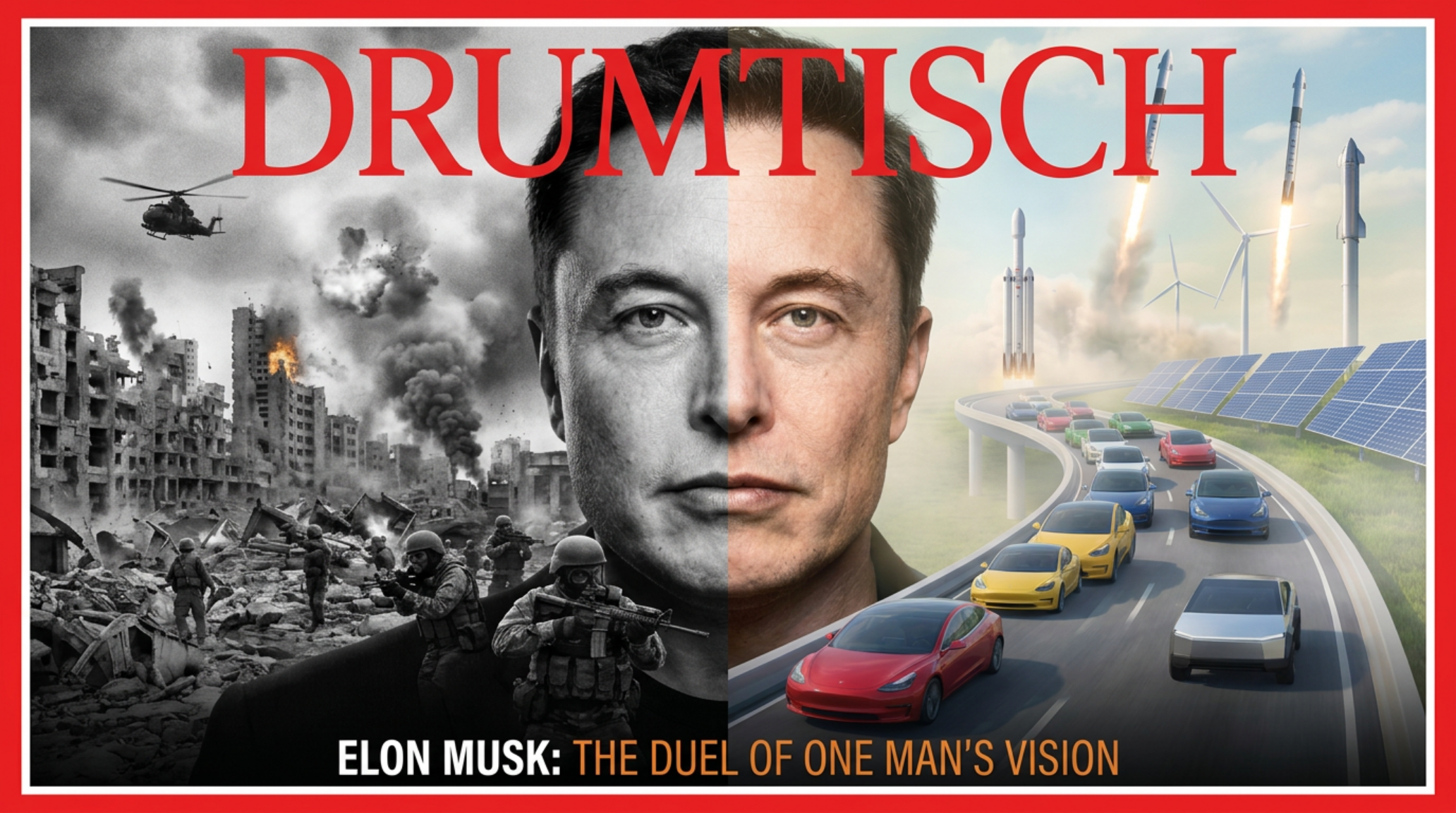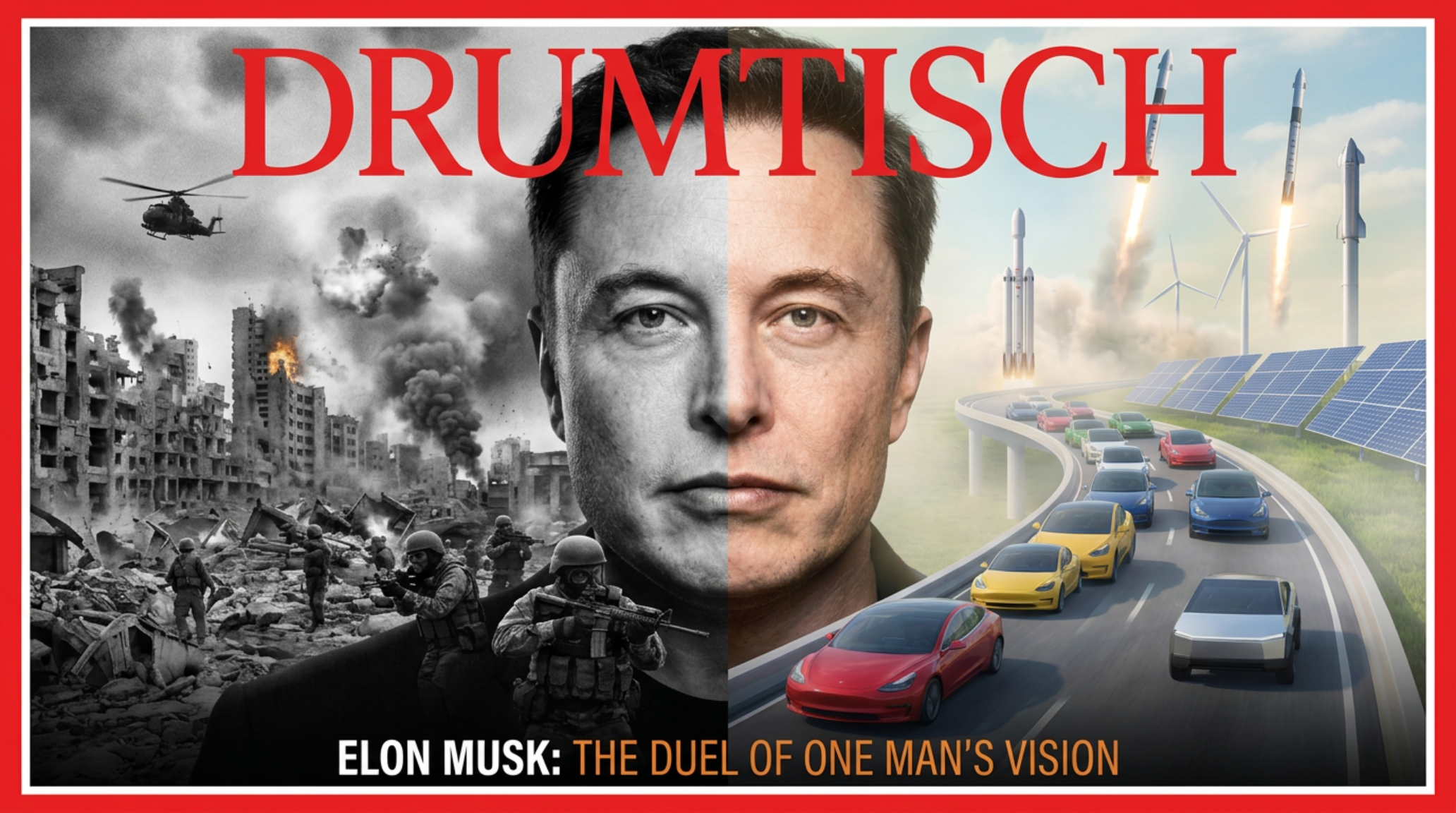
Rockets, satellites, military communications, artificial intelligence and a global media platform: Elon Musk has accumulated a concentration of private technological power that would once have belonged almost exclusively to states. That does not make him a Bond villain. But it raises a question democracies have barely begun to answer.
In James Bond films, the situation was usually quite clear. Any billionaire who owned his own rockets, space stations and satellite systems was almost certainly the villain. In Moonraker, Hugo Drax built a private space empire. Other Bond adversaries used satellites to blackmail governments, provoke wars or manipulate the international order. Audiences instinctively understood why that degree of power should not rest in the hands of a single individual.
Today, through SpaceX, Starlink, Starshield, X and xAI, Elon Musk commands a combination of space, communications and information power that even many states do not possess. He has no army, rules no country and owns no nuclear weapons. Yet governments and armed forces rely on technologies developed and operated by his companies.
So, is Elon Musk the most dangerous person in the world?
Taken literally, probably not. Heads of nuclear-armed states possess powers whose immediate destructive potential far exceeds anything Musk can command. He cannot mobilise troops, close borders, pass laws or order a military strike. To describe him simply as the most powerful person on Earth would confuse corporate influence with state sovereignty.
And yet the question is not as absurd as it first sounds.
Through his companies, Musk controls capabilities that until recently were almost exclusively the domain of governments, military alliances and intelligence services. SpaceX sends people, commercial payloads and classified satellites into orbit. Starlink operates a communications network consisting of more than 11,000 satellites. Starshield provides infrastructure specifically designed for government and military applications. X is one of the world’s major political communications platforms, while xAI is developing increasingly powerful artificial intelligence.
Each of those areas would be significant on its own. Their concentration around one entrepreneur is what makes the situation unusual.
In another era, James Bond would have been sent after him
James Bond films were rarely exercises in political subtlety, but they understood one idea remarkably well: private power becomes politically interesting when it begins to perform functions normally associated with states.
Hugo Drax in Moonraker is perhaps the most obvious example. The billionaire industrialist owns his own space company, develops spacecraft, operates a secret station in orbit and assembles a private team of astronauts. In Diamonds Are Forever, Ernst Stavro Blofeld uses a laser satellite to blackmail major powers. Alec Trevelyan attempts to use the GoldenEye satellite system to launch an electromagnetic attack on Britain, while media magnate Elliot Carver in Tomorrow Never Dies combines satellite technology, manipulation of navigation systems and media influence in an attempt to provoke war.
The message was always broadly the same: once a private individual possesses technology of military or geopolitical significance, the normal relationship between economic and political power begins to blur.
Elon Musk is obviously not Hugo Drax. There is no evidence of a secret plan to destroy humanity, no private army and no plan to populate space with a hand-picked elite. The comparison is therefore not a moral one. It is a cultural mirror.
What once served as the premise for a fictional supervillain has become part of the infrastructure on which modern states increasingly depend.
And that alone should make us curious.
Villain, genius, scientist – or something else entirely?
Musk is often portrayed in one of two extremes. Either he is treated as a scientific genius who personally invents almost everything associated with his companies, or as a technically clueless billionaire who simply hires clever people and takes the credit.
Neither description is particularly useful.
Musk studied first at Queen’s University in Canada before transferring to the University of Pennsylvania, where he earned degrees in physics and economics. He did not graduate as an engineer, nor does he hold a doctorate in physics, aerospace engineering or another technical discipline. He was accepted onto a postgraduate programme at Stanford University in 1995, but never began the course, choosing instead to pursue opportunities in the emerging internet economy.
Together with his brother Kimbal, he founded Zip2, followed later by X.com. The sale of and stakes in those early companies generated the capital that enabled him to finance later ventures.
He is therefore not a scientist in the traditional academic sense. He has not built a career around peer-reviewed research, experimental programmes or university institutes. What he does have is a background in physics, an exceptional ability to absorb technical information quickly and a rare capacity to combine engineering, capital and industrial organisation.
That distinction matters. Musk’s real talent may not be invention in the classical sense at all.
It may be systems integration.
The man who taught himself rocket science
When Musk founded SpaceX, he had neither a degree in aerospace engineering nor decades of experience in the rocket industry. According to people who worked with him in the early years, he attacked that knowledge gap aggressively. He read standard works on propulsion, aerothermodynamics, launch systems and orbital mechanics, surrounded himself with experienced specialists and absorbed technical information at remarkable speed.
Jim Cantrell, one of SpaceX’s early advisers, later described Musk as someone capable of learning technical textbooks almost by heart. At the same time, Musk recruited engineers such as propulsion specialist Tom Mueller, whose work was central to the development of SpaceX’s early engines.
That combination explains much of what makes Musk unusual. He does not need to design every engine himself or write every line of software to influence the technical direction of a company. He learns enough to challenge engineers, test assumptions, set demanding targets and connect different technical disciplines into a single industrial strategy.
His admirers sometimes turn that into the myth of the lone inventor. His critics sometimes reduce him to nothing more than the man with the money.
The truth is considerably more interesting.
Musk is not a lone inventor. He is an industrial systems architect.
What really makes Musk different
Musk rarely appears to think in terms of isolated products. He thinks in terms of systems in which development, manufacturing, software, infrastructure, energy supply and financing can be brought under common control.
Tesla does not merely manufacture cars. It also develops batteries, energy storage systems, charging infrastructure, software and increasingly AI-based driving functions. SpaceX does not simply build rockets. It manufactures engines, spacecraft, satellites and ground equipment. Starlink depends on launches carried out by SpaceX, while revenue from the communications network in turn helps finance further launch and satellite development.
That level of vertical integration creates speed.
A government has to approve budgets, organise procurement, comply with parliamentary procedures, coordinate ministries, work with allies and often bring several contractors together. SpaceX can develop, manufacture, launch and operate technology largely within one corporate ecosystem.
Musk also tends to ask different questions from established organisations. Why should the first stage of a rocket be thrown away after every launch? Why should a global communications network rely on a small number of enormous satellites instead of thousands of smaller ones and why should an electric car initially be sold as a rational environmental choice rather than as something desirable?
That mindset has produced spectacular successes. It has also produced missed deadlines, exaggerated promises and situations in which technical ambition has moved faster than political or institutional responsibility.
When the issue is whether a new car arrives two years late, that is mainly a commercial matter. When the same culture extends to military communications, satellite access and national security, the consequences become rather more serious.
SpaceX is no longer merely a rocket company
SpaceX now operates infrastructure that very few countries could reproduce independently.
The company transports astronauts, scientific missions, commercial satellites and classified government payloads. The US military and intelligence community rely heavily on SpaceX for launches, while Falcon 9 has become a central part of America’s access to orbit.
Its importance is not simply that the rocket works. SpaceX launches frequently, routinely recovers first stages and reuses them. That gives the company an industrial capability for rapid and comparatively inexpensive access to low Earth orbit that most states do not possess.
Then there is Starlink.
With more than 11,000 satellites, Starlink is fundamentally different from traditional communications constellations based on a relatively small number of large spacecraft. Losing one satellite in such a distributed system matters very little. Disabling thousands is a fundamentally different challenge.
That makes the network technically resilient.
It can also make users strategically dependent.
Starshield takes the concept further by tailoring satellite infrastructure to government and military requirements, including secure communications, Earth observation and the hosting of government payloads.
SpaceX therefore does not possess military power in the traditional sense. It owns no nuclear arsenal, fields no army and has no sovereign chain of command. But it controls several capabilities on which modern military power increasingly depends: access to orbit, satellite communications, rapid data transmission and the ability to replace large numbers of orbital assets quickly.
Which military can actually match SpaceX?
This is where the comparison requires some discipline.
The United States is obviously far more powerful than SpaceX overall. It possesses global intelligence networks, GPS, missile-warning systems, cyber capabilities, nuclear weapons, armed forces and sovereign political institutions. SpaceX cannot replace any of that.
Yet even the United States increasingly depends on Musk’s company in certain areas. SpaceX carries a substantial share of national-security payloads into orbit and provides communications services that complement state systems.
China is probably the clearest example of a country attempting to build an equally broad space-industrial ecosystem. It operates its own launch vehicles, space station, BeiDou navigation system, reconnaissance satellites, communications systems and counter-space capabilities. Militarily, China is of course vastly more capable than SpaceX. But in terms of launch frequency, routine rocket reuse and the scale of a low-Earth-orbit communications constellation, SpaceX remains exceptionally strong.
Russia has its own launch capability, military satellites, navigation infrastructure and powerful electronic-warfare systems. But in modern LEO communications, frequent launch operations and rapid constellation replacement, SpaceX has established capabilities Russia currently does not match.
France and the United Kingdom possess sovereign military communications and reconnaissance systems. Germany has military satellite communications, reconnaissance assets and a space command. Yet none of those countries operates anything resembling the complete SpaceX-Starlink industrial chain, from rocket production to launch and the operation of thousands of satellites.
That is the important distinction.
Musk is not more powerful than major states.
But through SpaceX, he controls individual capabilities that many states cannot reproduce themselves.
Ukraine showed why that matters
Russia’s full-scale invasion of Ukraine transformed Starlink from an impressive commercial technology into strategic infrastructure.
As terrestrial networks were damaged or disrupted, Starlink continued to provide connectivity for government bodies, hospitals, civilians and military units. Ukrainian forces used the network to exchange information, coordinate operations and operate drones. Russia possesses significant electronic-warfare capabilities, yet the distributed nature of the Starlink constellation made it difficult to suppress completely.
Technically, it was an extraordinary demonstration.
Politically, it exposed a problem.
In 2022, Ukraine asked for Starlink coverage to be extended around Russian-occupied Sevastopol in connection with a planned operation against Russia’s Black Sea Fleet. Musk declined to enable coverage. Early reports suggested that he had actively switched off a service already in use during the attack, but that version was later corrected. The region had not been activated in the first place.
That distinction matters. But it does not remove the underlying issue.
A private company and its controlling owner found themselves in the position of deciding whether strategically important communications infrastructure should support a military operation.
Musk argued that enabling the service could have made SpaceX directly complicit in an attack on Russian forces and risked escalation. One can regard that as responsible restraint. A private entrepreneur should perhaps not be making unilateral decisions to participate in warfare.
But that is precisely the point.
Why was a private entrepreneur in the position of having to make that decision at all?
The deeper failure may therefore lie not with Musk, but with governments that allowed a strategically important capability to depend on a grey zone between company policy, sanctions, military requirements and the personal judgement of a CEO.
Being dangerous does not require bad intentions
The word “dangerous” is easily misunderstood.
It sounds like an accusation of malicious intent. But risk and intent are not the same thing.
A dam can be dangerous without concrete harbouring evil intentions. A communications network can create strategic vulnerabilities while simultaneously providing enormous social benefits. An entrepreneur can acquire geopolitical influence without ever setting out to become involved in decisions about war and peace.
The more useful questions are structural.
What capabilities does somebody control? How independently can those capabilities be deployed and how dependent are others on them? How transparent are the relevant decisions and how quickly can a bad decision be reversed?
In Musk’s case, the answers are unusual. His companies possess enormous technical capabilities. Governments sometimes have very few short-term alternatives. Decision-making is not always transparent from the outside. At the same time, several different forms of technological and communications power sit within the same sphere of influence.
That does not make Musk the most dangerous person alive.
But it may make him the most powerful private operator of strategic infrastructure the modern world has yet seen.
SpaceX, Starlink, X and AI: the combination is the unusual part
SpaceX alone would already be remarkable. The unusual element is the overlap between several different kinds of power.
SpaceX controls physical infrastructure in space. Starlink provides communications access. Starshield serves security and military customers. X influences the political public sphere. xAI develops systems capable of analysing, generating and distributing information at enormous scale.
These companies are not a unified military organisation and their capabilities cannot simply be added together as though they were one machine. Nevertheless, they are strongly associated with the same entrepreneur.
That is historically unusual.
A traditional defence contractor may build rockets, satellites or communications systems, but usually does not also own a global media platform. A media entrepreneur may influence politics, but normally does not control a space-launch company. An AI company may process huge quantities of information, but rarely owns the physical communications infrastructure through which some of that information travels.
With Musk, these worlds overlap.
That creates a form of private power for which our political vocabulary still feels strangely inadequate.
There are important limits to Musk’s power
None of this means Musk operates outside government control.
SpaceX requires launch licences, frequency allocations, export approvals, safety authorisations and access to regulated infrastructure. Pentagon and government contracts contain legal obligations and oversight mechanisms.
Musk cannot simply switch off American military satellites whenever he chooses, nor does he personally control every operational aspect of Starshield. SpaceX is a large organisation with engineers, security personnel, managers and contractual partners. Gwynne Shotwell, the company’s President and Chief Operating Officer, has played a central role in running SpaceX for years.
The businesses also remain economically dependent on governments. SpaceX earns substantial revenue through public contracts. Starlink requires spectrum rights and licences in the countries in which it operates. Tesla has benefited from regulatory frameworks and subsidy programmes.
Governments retain significant power. They can alter contracts, regulate markets, support competitors and, in extreme circumstances, intervene in strategically important infrastructure.
The caricature of Musk sitting alone in a control room, pressing a button and deciding the fate of nations, is therefore nonsense.
But so is the opposite caricature, in which he is merely another businessman with no exceptional geopolitical influence.
Rreality lies somewhere between the two.
The real danger is dependence
The greatest risk emerges when alternatives disappear.
A satellite system can be technically resilient and still create political vulnerability if the user has nowhere else to go. A government that depends on Starlink during a war also depends on the technical conditions, geographical permissions, contracts and decision-making structures surrounding Starlink.
The first danger is therefore strategic dependence.
The second is unclear responsibility. If a connection is restricted during a military operation, it must be immediately obvious who made that decision and under what authority. Was it SpaceX? Musk personally? The Pentagon? The White House? A contractual limitation? Governments should not discover the answer while an operation is already under way.
The third problem is personalisation. Critical infrastructure should not depend on one entrepreneur always being sensible, neutral and predictable. Even if Musk made every major decision perfectly, the structure would still need to remain safe under someone less capable, less stable or less responsible.
Democracies do not write constitutions for the perfect ruler. They write them for the possibility that one day the wrong person may hold power.
Critical infrastructure deserves the same logic.
Europe needs an alternative, not an anti-Musk campaign
The answer is not to demonise Elon Musk. Nor is it to rely on his good intentions.
Both approaches are strategically lazy.
Governments need redundancy. Armed forces require several independent communications systems that can be used together and substituted for one another. No military should depend entirely on one private provider, no matter how technically impressive that provider may be.
Contracts must define exactly where systems can be used, what applications are permitted, who has authority to restrict them and how political decision-makers are informed. No entrepreneur should be left alone to balance commercial interests, escalation risk and military necessity during an active conflict.
Europe also needs to strengthen its own capabilities. Galileo proved that European countries can create global space infrastructure together. IRIS² is intended to provide secure European satellite communications, but the programme needs to progress quickly enough to become a genuine strategic alternative rather than an interesting project that arrives years after the dependency has already been established.
The same applies to launch capacity.
Competition is not an argument against SpaceX. Quite the opposite. SpaceX has demonstrated what is technically and economically possible. The strategic response should be to build credible alternatives.
Because no matter how efficient a private company may be, when virtually every alternative is slower, more expensive or less capable, commercial dominance begins to become a political issue.
So, is Elon Musk the most dangerous person in the world?
No. At least not in the literal sense.
Leaders of nuclear powers can make decisions within minutes whose destructive potential exceeds anything Musk currently controls. Military commanders possess weapons, intelligence networks and sovereign authority that SpaceX does not have. Terrorist and criminal organisations may pose far more immediate threats to human life.
But Musk may be one of the most consequential private power brokers of our time.
His companies influence access to space, communications during war, political discourse, technological development and artificial intelligence. Their strategic importance reaches far beyond normal corporate influence.
The key question is therefore not whether Musk personally represents a threat to humanity.
It is whether democratic societies should become dependent on strategic systems whose direction is so closely associated with one individual.
That is where the real risk lies.
Conclusion: perhaps James Bond understood something after all
Not every billionaire with rockets and satellites is automatically a villain. But anyone who accumulates that level of strategic power deserves scrutiny, clear rules and effective limits.
Elon Musk has achieved things that governments, established corporations and extremely well-funded organisations struggled to achieve. He helped turn reusable rockets from an ambitious engineering objective into routine operations. His companies built a global satellite communications network and accelerated commercial spaceflight at a pace that would have sounded extraordinary only a few decades ago.
Those achievements cannot simply be dismissed as luck, money or the work of other people.
At the same time, technical brilliance is not the same as political wisdom.
Someone who builds exceptional rockets does not automatically understand the interests of a country under attack, the logic of escalation in war or the democratic legitimacy of foreign-policy decisions. Those are fundamentally different disciplines.
Musk is neither Hugo Drax nor the selfless scientific visionary some admirers would like him to be. He is an exceptionally capable entrepreneur who, through the success of his companies, has grown into a geopolitical role for which our political systems have not yet developed convincing rules.
Perhaps he is not the most dangerous person in the world.
But he may be the clearest example yet of how one private entrepreneur can accumulate a level of power that, until very recently, we would have associated almost exclusively with states.
Or, indeed, with villains in the cinema.
Link to the article: Is Elon Musk the most dangerous person in the world?
German version of the article: Ist Elon Musk der gefährlichste Mensch der Welt?
Entdecke mehr von DRUMTISCH
Melde dich für ein Abonnement an, um die neuesten Beiträge per E-Mail zu erhalten.